Monday, 23 May 2016

Course Update

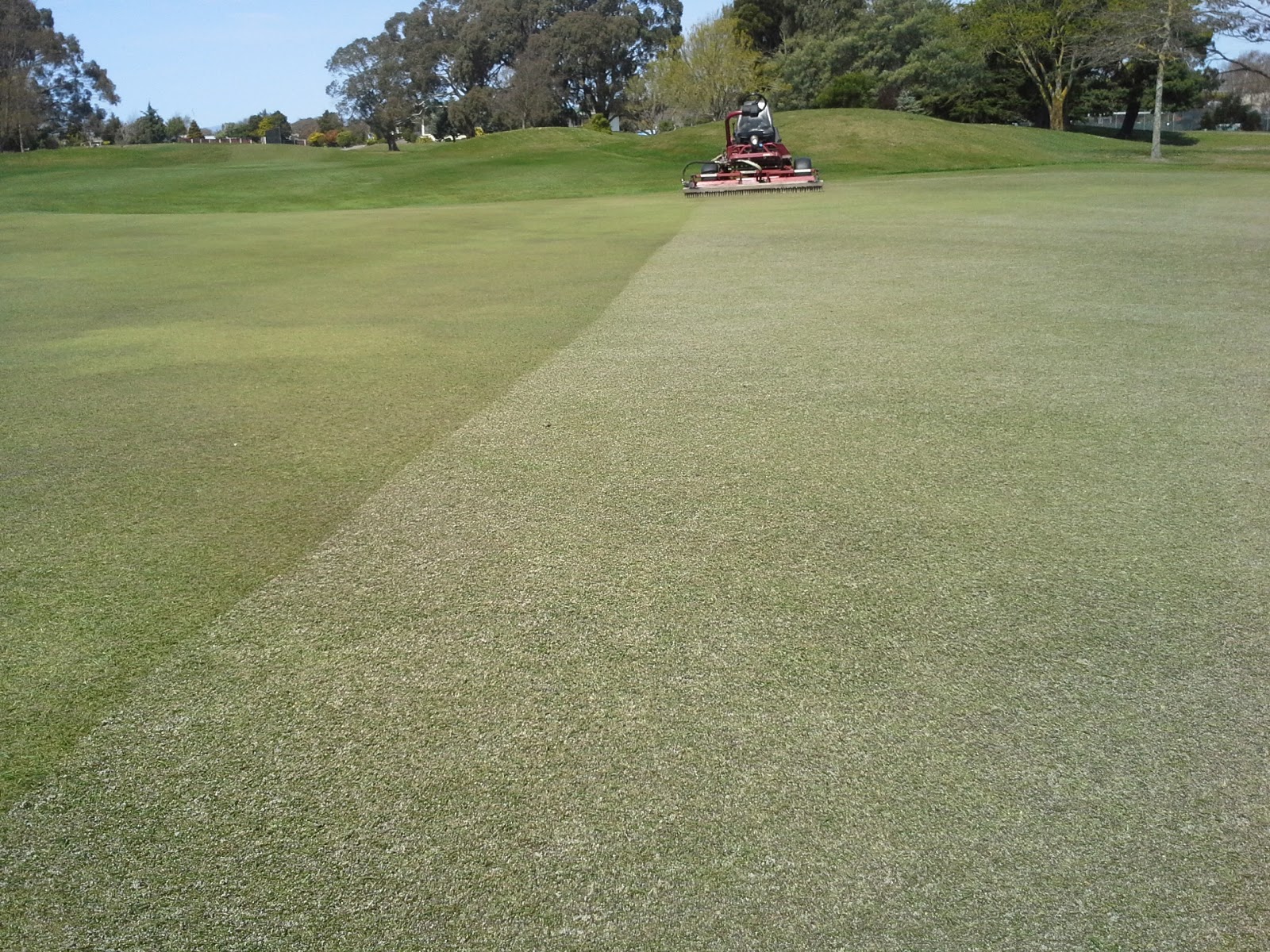
Since the last post we have had unseasonably warm, dry weather which has been fantastic for the establishment of the newly over-seeded fairways. We had seed germination after 2 weeks and all of the thinner areas are coming away nicely and the grass cover throughout has been kicked along with weekly foliar applications of  Ammonium Sulphate.
Seed germination in a bare area after 2 weeks

One of the projects that we have managed to do was the removal of the remains of the old path between the 3rd green and the 4th tee. The old buried rubble was causing a lot of rutting from the cart traffic and was also very difficult to keep moisture in the profile because it was very shallow. Once this material was removed we filled it with fresh soil, added an extra sprinkler and control cable at the 4th tee end and seeded it with Fescue and Browntop. Hopefully we will get germination before winter really sets in.
Newly seeded walkway to 4th tee
For some time I have been researching methods to control earthworm castings on our fairways and tees. Since the removal of Thiodan for earthworm control, our fairways have worsened each year to the point they became very muddy in areas certain times of the year. We haven't had much success with the various methods we have tried and products like Earlybird were very expensive to apply to large areas. Recently I was told about a granular version that had just been released and was considerably better value for money. I was very quick to get some granules to try out before we got into the "muddy" season. I have trialled it in about 10 areas of the course that has historically been very bad for castings. Once applied it was heavily watered in and within  10-15 minutes hundreds of earthworms were at the surface. Since the application we have had over 50mm of rainfall over weekend and thousands of earthworms have surfaced. Very impressive! It will be interesting to see how long the earthworms will be suppressed for until another application is required.

Tea seed pellets for earthworm control
Earthworms on the surface after weekend rain


Wednesday, 6 April 2016

What's happening on the course

It's been a very busy time on the golf course since my last post. We have had a very warm, dry summer and it was a great test to see how the irrigation system would perform after the  control system and wiring were recently repaired. Well I can say it worked a treat with no issues at all other than a pipe repair on the 3rd fairway which was probably a remnant of the damage from the earthquakes.
Damage to an 80mm fitting after some recent shakes

The repaired pipe

With the warm weather came very strong turf growth over the whole course. During this time I had a lot of trouble keeping the greens at a good speed even with the use of growth regulators and very little nitrogen applied. The tees, fairways and rough were also needing quite frequent mowing which took up a lot of our time. Leading up to our renovations on the greens I only applied foliar nitrogen at 10kg/Ha a week prior to vertidraining with 18mm solid tynes and we got amazing recovery. We were nearly back to normal mowing height 2 weeks after renovation with no extra fertiliser.
The 9th green 2 weeks after 18mm solid tynes and topdressing.
Recently we got news that funding had been approved for the purchase of a topdressing machine and we chose to buy a Dakota 410 towed topdresser. This machine can put out topdressing at a heavy rate or very lightly to dust. It can also be used to spread fertiliser. This purchase will allow us to dust our greens on a regular basis through the growing season and help dilute thatch, firm the surfaces even more and help with better smoothness and ball roll. This will be a major improvement on how we have been able to manage our greens previously.
An example of the Dakota 410 applying a very light dusting.
Our most recent project on the course was completed today and that was the overseeding of all the fairways with a fine fescue/browntop mix. Over the last 3 years we have been gradually removing the ryegrass from the fairways and encouraging the browntop and fescue to take over. This process has been fairly successful and we were now at the point where we could introduce more browntop and fescue without it having to compete with other grasses. We will have about 8 weeks for the seed to establish before we hit the colder months of winter when the grass growth will slow down. Next spring and summer should enable us to thicken up the turf and have a much better fairway surface with a more dense stand of turf.
Seed drill in action

The slits where the seed is placed

Close up of the seed sitting in the slit 


.

Sunday, 20 December 2015

Course Update

This past week we have managed to install all the sprinkler decoders that had been removed and sent for testing in Auckland. With the decoders in ground we ran several tests through the decoder diagnostics tool on our computer and once I was satisfied that everything was working correctly all the holes were filled back in, levelled and seeded in any bare areas.
Another job that had been hanging around for a little while was a pipe leak repair on the 10th fairway. The leak was in a 150 mm pipe mainline and with the dry weather we have been having I was waiting for some rain so if there was any delay in the repair it wouldn't affect our irrigation too much. As it turned out we had quite a rain and hailstorm last Sunday which provided a good opportunity to shut the system down and make the repair.
Storm clouds approaching

Draining the pipeline

Mainline with tee pieces

Faulty 150mm pipe removed from tee piece

The finished repair

The damaged pipe worn by water pressure

With the irrigation repair finished and back-filled the golf course had returned to normal playing condition for the first time since mid July. We haven't had the course free of holes on fairways, tees or rough since July because of all the searching for faults and repairs we were making to get the irrigation system operating properly. With this year nearing the end I am hoping that 2016 brings us less trying conditions so that we can concentrate on maintaining and grooming the golf course.

Sunday, 6 December 2015

Course Update

After many months looking for wiring faults in our irrigation system we have finally found the major cause of our problems. The decoder interface had an intermittent fault that eventually worsened to the point that it failed completely and we had no power to the course at all. Fortunately we were supplied a temporary interface until a new one could be shipped from overseas. We are now full operational with the new LDI installed.
We have sent our suspect decoders to Auckland for testing and are waiting for them to be returned so that we can finish the repairs to the system and fill in the holes on the fairways.
New LDI installed
Now the irrigation system has been sorted we have been able to do more regular mowing and maintenance around the course. The fairways are starting to show the benefits of more regular mowing and areas of the rough are really starting to be defined with the dry weather burning off  the grass and the seedhead growing and lengthening.
Regular fairway mowing and rough drying out
With more regular watering and limited preseason maintenance done on the system due to chasing our electrical issues we were bound to have some problems crop up. One of or pumps had a fuse burn out, several pipe leaks have appeared and an unusual pipe problem at another pump shed recently appeared.
Deformed, leaking pipe at pump shed 3


Sunday, 11 October 2015

Course update

Sorry for the long delay between posts but it has been a frustrating time dealing with the issues with our irrigation system. The problems that we had with the irrigation wiring still hasn't been resolved fully but as of last night I have been able to run an automatic cycle successfully for the first time this season. We have made repairs to dozens of damaged sections of cable, replaced or isolated about 15 decoders that have malfunctioned and replaced about 60 old cable joiners. With all of these areas being repaired or isolated we are still getting an inconsistent line current that can't be located by myself or the Rainbird technician. We will continue our search for the fault as time permits as we are now in full swing with spring mowing, wetting agent program and fertilising.

On a more positive note we have just completed our greens renovation program. With our irrigation system being in a fragile state I decided to do a light renovation to the greens because I was unsure I would be able to actually apply enough water to get full recovery.
I decided to vertidrain with 8mm solid pencil tynes to a 150mm depth 25 mm apart. This would give us lots of holes through the greens profile that would allow good penetration of the irrigation water when it is applied. The greens were also double verticut to remove excess leaf and lightly topdressed to smooth the surface. The greens were then brushed and rolled to get the sand into the turf canopy. Once this process was completed all greens were treated with a long term (3 month) wetting agent and washed in with the irrigation system. We achieved all of this on Monday and Tuesday and were back open on Wednesday for the mid week comp with minimal surface disruption. Below are some photos of the process.
vertidrain with 8mm solid tynes

closeup of the vertidrain holes

green after verticutting

topdressing being brushed in

closeup of the brush and rollers


Friday, 14 August 2015

Irrigation control cable fault finding update

Since the last post when I mentioned that we had a fault in the control cable we started to go through the entire irrigation system to track down any problems before we need to fire up the system in spring. This has now turned into a major hunt for damage to the control cable as at one point the system had totally shut down. For the last 4 weeks we have constantly been fault finding the system and as the golfers would have noticed we have had to dig holes all over the course locating possible bad joins, damaged cable and faulty decoders.

Faulty decoder

Cable that appears to be stretched  under a pipe with fused sand around the exposed wire


Vertidrain damage to shallow cable

More damaged cable

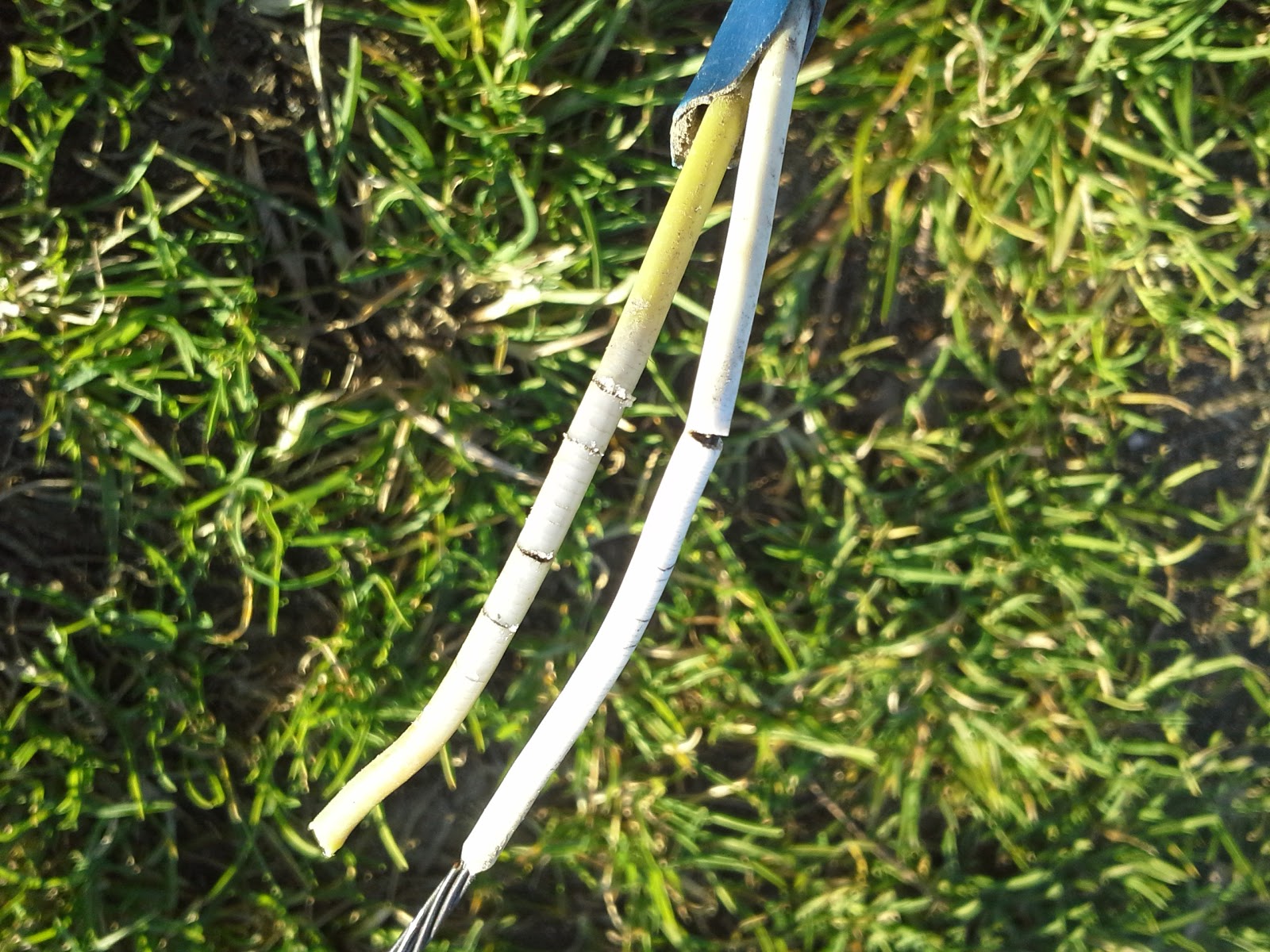
Cracks in the cable insulation


Two cables shorted together

Two more cables shorted together

Over the course of  the last 4 weeks we have replaced 3 faulty or shorted decoders, replaced dozens of  faulty joiners, cut out about 12 areas of damaged cable and have been continually tracing and testing cable over the entire course. At the moment we still don't have a functioning irrigation system despite all our efforts. We have had advice and help from the local Rainbird technician and  he is coming in on Tuesday for the day to see if he can get to the bottom of our problems. The issues we are having appear to be a combination of  the age of the components in the system (25 years or older), the fact that we have had massive ground upheaval with over 15,000 earthquakes and aftershocks and in some instances poor installation practises.
At this point I'm not discounting damage to the irrigation control unit as one of the sources of the problems so hopefully we can get this tested Tuesday when the technician visits.

Tuesday, 7 July 2015

Course Update

Since the last post we have managed to vertidrain the fairways one more time taking advantage of the relatively dry conditions. By creating more channels in the soil profile we have a better the chance of getting rid of surface water when we do get heavy rainfall. 

We have kept an eye on the water table recently on an area on our 17th fairway where we had dug a sump. Last winter the water table was sitting at just 300mm below the level of the fairway. At the moment we haven't hit the water table and we have dug down 600mm. All very promising with us reaching the middle of our winter.


We haven't reached the water table at 600mm

One of the downsides to vertidraining areas of the golf course is the damage it can cause to the irrigation control cable. As I have mentioned previously there are areas of cable that have been installed at a shallow depth and every now and again we strike the cable with the machine and we eventually lose power to the watering system. This has been the case recently on an area where the fairway had been extended closer to the ladies tee. Unfortunately this area had the cable installed at approximately 75mm depth and at some point the tynes of the vertidrain had punctured the cable casing and damaged the wire.
Once this problem has been repaired we will check the entire course with the cable locator and check for any other problem areas so that we are in good shape for the summer watering season.

Setting up the cable locator

Cable damage

Cable installed 75mm deep