Sunday, 11 October 2015

Course update

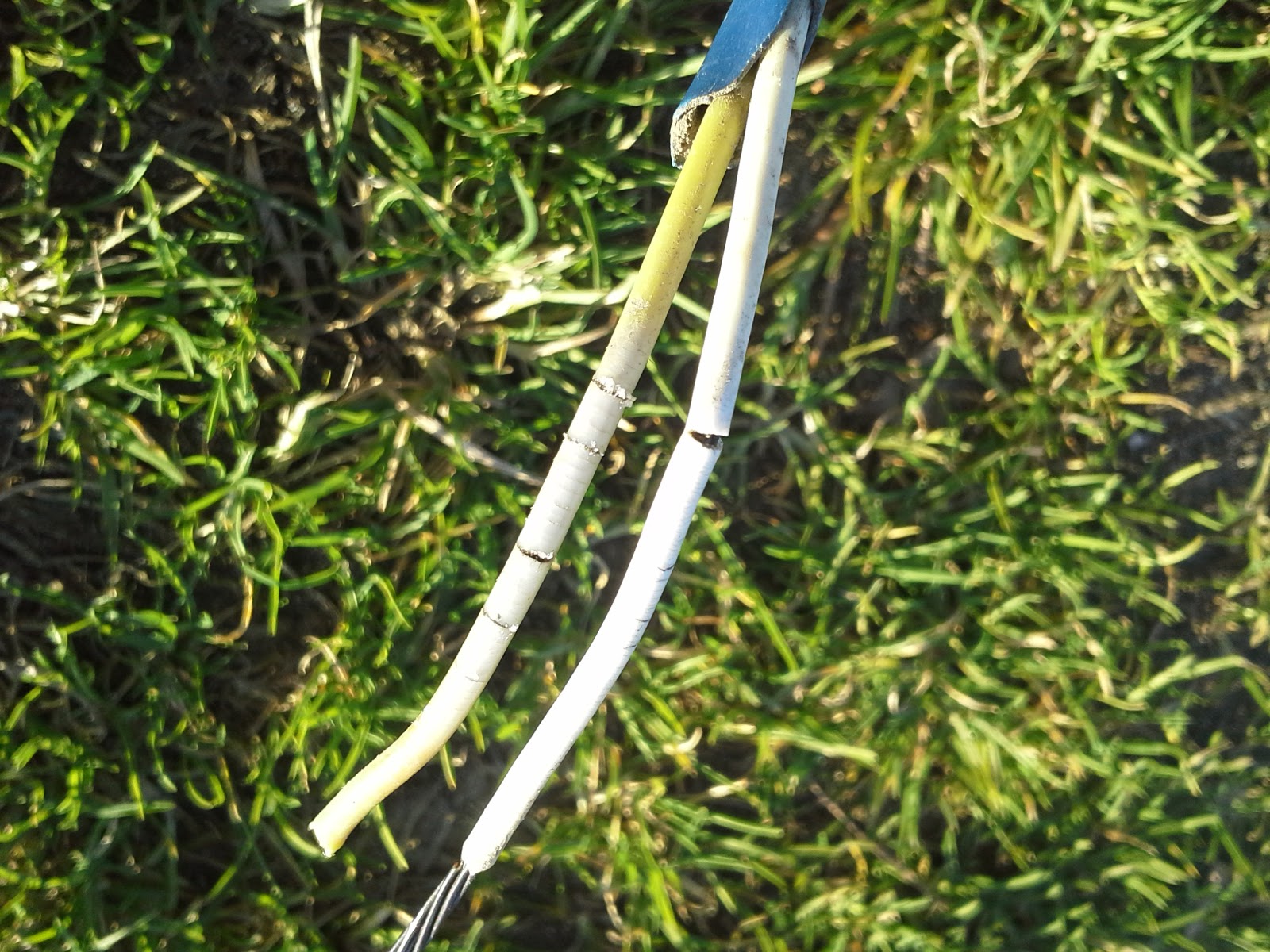
Sorry for the long delay between posts but it has been a frustrating time dealing with the issues with our irrigation system. The problems that we had with the irrigation wiring still hasn't been resolved fully but as of last night I have been able to run an automatic cycle successfully for the first time this season. We have made repairs to dozens of damaged sections of cable, replaced or isolated about 15 decoders that have malfunctioned and replaced about 60 old cable joiners. With all of these areas being repaired or isolated we are still getting an inconsistent line current that can't be located by myself or the Rainbird technician. We will continue our search for the fault as time permits as we are now in full swing with spring mowing, wetting agent program and fertilising.

On a more positive note we have just completed our greens renovation program. With our irrigation system being in a fragile state I decided to do a light renovation to the greens because I was unsure I would be able to actually apply enough water to get full recovery.
I decided to vertidrain with 8mm solid pencil tynes to a 150mm depth 25 mm apart. This would give us lots of holes through the greens profile that would allow good penetration of the irrigation water when it is applied. The greens were also double verticut to remove excess leaf and lightly topdressed to smooth the surface. The greens were then brushed and rolled to get the sand into the turf canopy. Once this process was completed all greens were treated with a long term (3 month) wetting agent and washed in with the irrigation system. We achieved all of this on Monday and Tuesday and were back open on Wednesday for the mid week comp with minimal surface disruption. Below are some photos of the process.
vertidrain with 8mm solid tynes

closeup of the vertidrain holes

green after verticutting

topdressing being brushed in

closeup of the brush and rollers


Friday, 14 August 2015

Irrigation control cable fault finding update

Since the last post when I mentioned that we had a fault in the control cable we started to go through the entire irrigation system to track down any problems before we need to fire up the system in spring. This has now turned into a major hunt for damage to the control cable as at one point the system had totally shut down. For the last 4 weeks we have constantly been fault finding the system and as the golfers would have noticed we have had to dig holes all over the course locating possible bad joins, damaged cable and faulty decoders.

Faulty decoder

Cable that appears to be stretched  under a pipe with fused sand around the exposed wire


Vertidrain damage to shallow cable

More damaged cable

Cracks in the cable insulation


Two cables shorted together

Two more cables shorted together

Over the course of  the last 4 weeks we have replaced 3 faulty or shorted decoders, replaced dozens of  faulty joiners, cut out about 12 areas of damaged cable and have been continually tracing and testing cable over the entire course. At the moment we still don't have a functioning irrigation system despite all our efforts. We have had advice and help from the local Rainbird technician and  he is coming in on Tuesday for the day to see if he can get to the bottom of our problems. The issues we are having appear to be a combination of  the age of the components in the system (25 years or older), the fact that we have had massive ground upheaval with over 15,000 earthquakes and aftershocks and in some instances poor installation practises.
At this point I'm not discounting damage to the irrigation control unit as one of the sources of the problems so hopefully we can get this tested Tuesday when the technician visits.

Tuesday, 7 July 2015

Course Update

Since the last post we have managed to vertidrain the fairways one more time taking advantage of the relatively dry conditions. By creating more channels in the soil profile we have a better the chance of getting rid of surface water when we do get heavy rainfall. 

We have kept an eye on the water table recently on an area on our 17th fairway where we had dug a sump. Last winter the water table was sitting at just 300mm below the level of the fairway. At the moment we haven't hit the water table and we have dug down 600mm. All very promising with us reaching the middle of our winter.


We haven't reached the water table at 600mm

One of the downsides to vertidraining areas of the golf course is the damage it can cause to the irrigation control cable. As I have mentioned previously there are areas of cable that have been installed at a shallow depth and every now and again we strike the cable with the machine and we eventually lose power to the watering system. This has been the case recently on an area where the fairway had been extended closer to the ladies tee. Unfortunately this area had the cable installed at approximately 75mm depth and at some point the tynes of the vertidrain had punctured the cable casing and damaged the wire.
Once this problem has been repaired we will check the entire course with the cable locator and check for any other problem areas so that we are in good shape for the summer watering season.

Setting up the cable locator

Cable damage

Cable installed 75mm deep


Wednesday, 17 June 2015

Nice frost

Today has started with a -3.8 degree frost that will stay around for some time. We are one of the few courses in Canterbury that allow play during a frost so we do our best to limit damage by asking members to keep cart travel off the fairways and away from greens. I must say I don't see what the attraction is in playing golf in these conditions.

18th fairway
9th green
Trundler marks that will be black tomorrow
Keen golfers

Sunday, 17 May 2015

Course Update

We have now finished the vertidraining of all fairways and are in a bit better position as far as drainage goes if we start getting more frequent rainfall. I have recently checked the water table level on the 17th fairway to see how we are looking compared to this time last year. The water table at the moment is about 500mm below the fairway surface (this time last year it was at 300mm below the surface) so we have more chance of the fairway draining in the event of a large amount of rain falling.

One thing to point out at the moment is the continual loss of gum trees around the course. For no particular reason, large well established gum trees are dying in random places around the course. The latest gum tree to die is between the 2nd fairway and 17th tee and is the fifth large gum tree to die within the last 2-3 months.
Dead gum near the 17th tee 

With the onset of cooler, damper conditions we are always on the lookout for diseases that can occur this time of year. The main disease we get this time of year is Fusarium and mainly affects the greens. We normally have a couple of areas that tend to show signs of disease and these indicator greens guide us on when or if we spray to treat the problem. Recently these hot spots increased in activity so we decided to get a fungicide out on all greens to protect them from major damage as the environmental conditions were very favourable for the spread of Fusarium.
Typical signs of Fusarium

Another recent irrigation repair was made to the control cable near the back of the 11th green. A fault appeared and we had no communication to any sprinklers down the 10th and 11th fairways so I knew that a cable was severed. As we had recently finished vertidraining I suspected a shallow cable was cut. Knowing roughly the position of the cable and what sprinklers were affected I worked out that the damage was done in an area not recently vertidrained. It turns out that it was old damage from vertidraining surrounds that suddenly gave out.
Cable damage near the 11th green (note the burnt ends of the cable totally separating the wire)

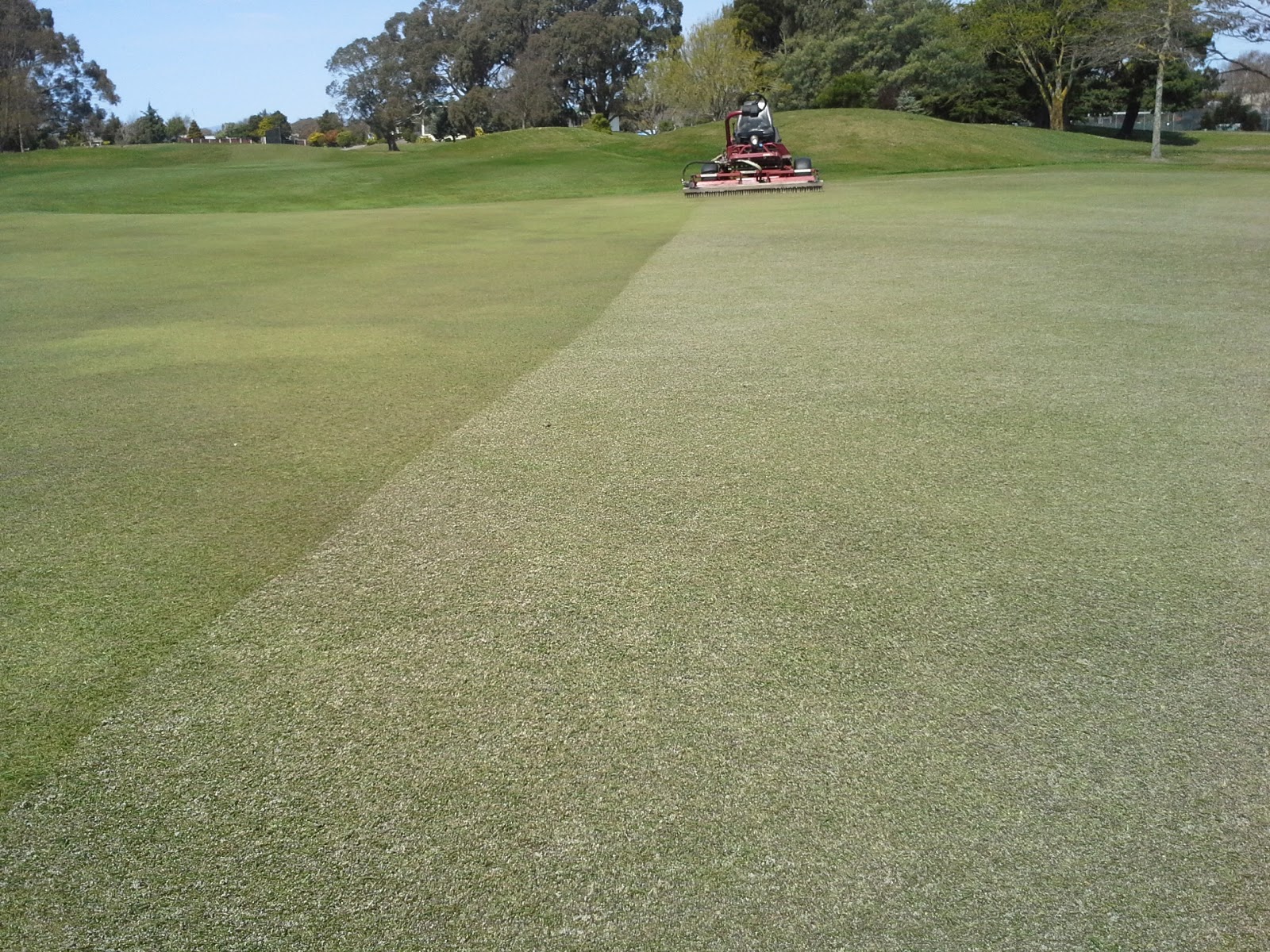
Recently we had a heavy morning fog which closed in suddenly leaving the golf course looking very eerie. Below are some photos from the 10th fairway.


  

Thursday, 30 April 2015

Course Update

It has been a while since the last post so I thought I would update everyone about what has been happening. With short working weeks with Easter and Anzac Day, as well as being short staffed due to a family bereavement, it has been fairly slow progress with the fairway vertidraining.
We will finish all vertidraining early next week and it should help with removing surface water when we eventually get heavy rainfall. This month has bought a change in weather with cooler conditions, regular rainfall without any downpours and some strong winds. Winter is just around the corner.

The cooler weather has bought about a slow down in turf growth so the mowing has reduced and cutting heights have been raised slightly to maintain good turf density through winter. One issue we deal with this time of year is the increased number of worm castings on the surface of the fairways. The castings get smeared on the surface with machinery, golf carts and foot traffic and the fairways look quite muddy. A few years ago we had a chemical that had good long term control of the worms, but unfortunately that is now off the market and there is nothing that is available that has good control and not too expensive. We are trying to acidify the surface of the fairways with regular applications of Sulphate of Ammonia to try and discourage the worms. This will be an ongoing process.


Monday, 23 March 2015

Fairway Vertidraining


We have started vertidraining the fairways with 18mm solid tynes to try and break up the hardpan under the surface. At the moment we are concentrating on the low areas on fairways that caused us problems last year with ponding for long periods of time after we received heavy rain early last year.

We have had a report done on our drainage issues in these areas by NZSTI and one of the recommendations in that report was to try and shatter the layer of  heavy, silty loam that sits on top of the sand profile. Our worst layer is on the 17th fairway which is more than 300mm thick in places and vertidraining will only punch down to about 250mm deep. I am hoping that we have some shattering affect that will crack through the layer in places and give us better water infiltration when we do get heavy rain. At least we will have a lot more air space in the soil profile that will hold more moisture when it does rain and hopefully get it away from the surface.

At the moment we have vertidrained the low areas on the 8th, 9th &17th fairways 3 times and increased the tyne depth 25 mm each time because the ground is so hard and the machine can't cope with full depth straight away. We are now at 175mm deep and will probably need to tyne these areas at least 3 more times before we are at our maximum depth. When we have completed these areas we will start on all fairways before winter hits. Most of our fairway drain fairly well because we don't have many areas with thick layers of silty loam so these won't need to be treated so severely and to such a depth. We should be able to easily punch holes down to 150-175mm without much problem as long as we avoid shallow pipework and cable which is always a possibility.


vertidrain with 18mm solid tyned

vertidrain holes in one of the hardpan areas on 17th fairway